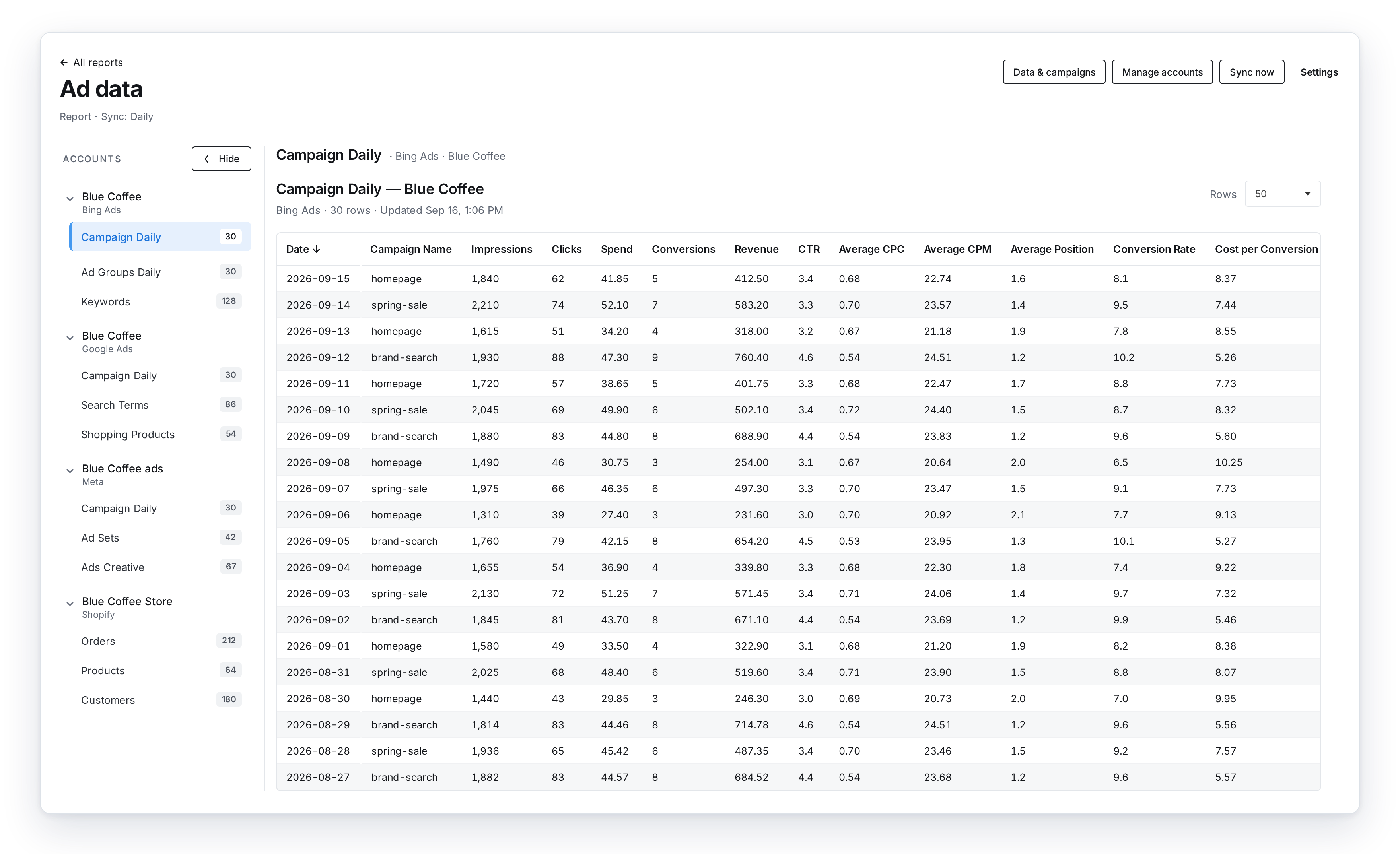
Managed Reports
Connect Shopify, Meta, Google Ads, and more. SyncRange keeps your tables fresh on a schedule and stores them for you, so you can browse and sort without setting up your own warehouse or spreadsheet destination.
Available on Growth · Uses your existing connections
Same connections. Different job.
Exporters send data to Sheets, BigQuery, or Excel you own. Reports sync into SyncRange-managed storage and show tables in the app.
Write to destinations you control: Google Sheets, your BigQuery project, or Excel.
Sync into storage SyncRange runs for you, then browse tables inside SyncRange.
Fresh tables without the plumbing
Hourly, daily, weekly, monthly, or manual. Backfill history once, then keep tables current.
Pick which data types and fields to sync per account. For ads, optionally limit to specific campaigns.
Skip creating a BigQuery project or sheet. Open a report, pick a table, and browse with sort and pagination.
Create a report in minutes
Link Shopify, ads, and Google properties under Apps. Reports reuse the same connections as exporters.
Name it, set backfill days, pick a data location, choose a sync schedule, and add one or more accounts.
Select tables and columns per account. For ad sources, filter to specific campaigns or leave empty for all.
Open the report to explore tables. Sync runs on your schedule, or hit Sync now anytime.
Add any connected account to a report
Included on Growth
Managed Reports are available on the Growth plan. Each account you add to a report counts as one exporter toward your plan limit, the same bucket used by Sheets exports, Data Blends, and AI tool connections.
No. SyncRange manages storage behind Reports. You browse tables in the app and do not configure a destination sheet or warehouse for the report itself.
Yes. Reports do not replace exporters. Use exporters when you need data in a destination you own, and Reports when you want synced tables inside SyncRange.
Each account on a report uses one exporter slot. The same account on two reports uses two slots. An export plus that account on a report also uses two slots.
Yes. When you create a report you pick a data location (region). SyncRange stores that report’s data there. The location cannot be changed later, so choose carefully at create time. You still do not need your own BigQuery project; SyncRange manages the warehouse.
Deleting a report removes it and the SyncRange-managed data for that report, and frees the exporter slots for accounts that were on it.
Social proof
See how teams export clean ecommerce and marketing data to BigQuery, Google Sheets, or Excel without manual work.
Shopify Store and Food delivery
Super easy to use and has been extremely useful in getting the real time data we need from our Shopify store. Ryan was super helpful in getting started, and responded to questions within minutes. Highly recommend.
Multi-brand Shopify Plus Operator
We run multiple Shopify stores and needed brand-level exports into BigQuery without custom pipeline maintenance. SyncRange gave us reliable scheduled exports and removed hours of manual QA.
Large marketplace
We struggled to find a Shopify extraction tool that went beyond basic product, order, and customer data until we found SyncRange. It effortlessly pulls everything we require, including metaobjects and custom fields. SyncRange's hands-on guidance has given us complete confidence.
Large Shopify Store
SyncRange was very helpful setting up Report Automation for my store. Highly recommend, Ryan made it as simple as possible and was very easy to work with. I recommend.
Create a Managed Report, sync the accounts you care about, and browse fresh tables without warehouse setup.